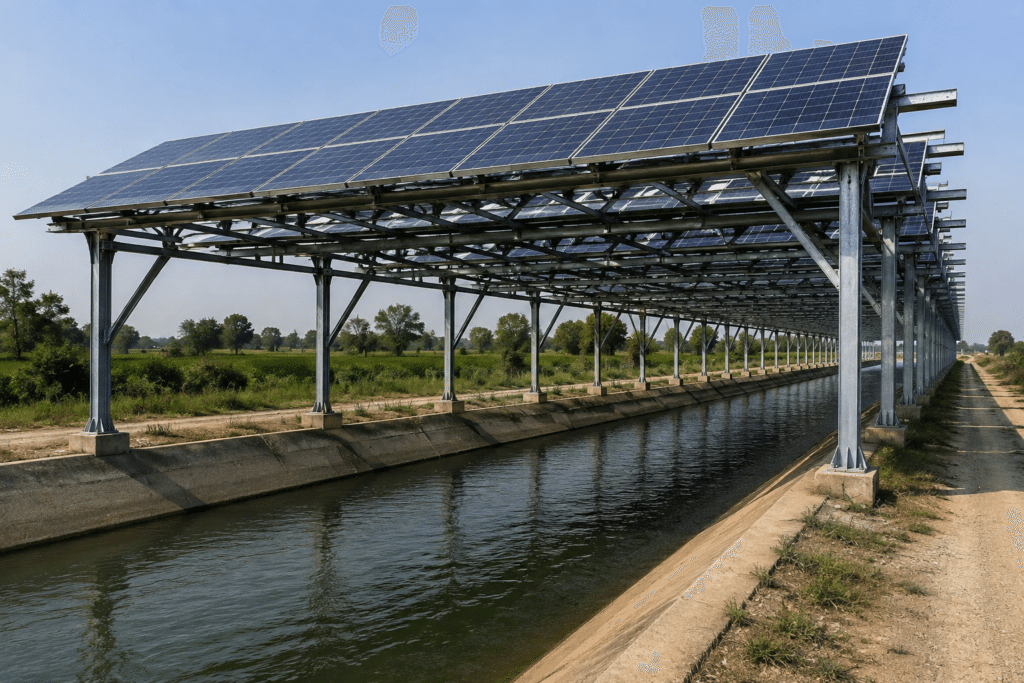
India’s renewable energy push runs into a stubborn problem almost everywhere it turns: solar farms need land, and in a country of 1.4 billion people, land is the one thing nobody has to spare. Every acre given to a solar park is an acre that isn’t growing wheat, cotton, or vegetables.
Gujarat answered that problem in a way that, in hindsight, looks obvious, but took engineers years to actually try. Instead of clearing new ground for solar panels, the state started building them over land that was already spoken for: its irrigation canals.
More than a decade later, that idea, canal top solar, is still one of the most quietly effective renewable energy experiments in the country. Here’s a clear-eyed look at how it works, what it has actually delivered, and why it hasn’t been rolled out across every canal in India.
Why Canals, of All Places?
Utility scale solar farms are land hungry by design. On average, a 1 MW ground-mounted solar power plant requires approximately 4 to 5 acres of flat, open land. Scale that up to gigawatt sized solar parks, and you’re talking about tens of thousands of hectares, land that often overlaps with farmland, grazing tracts, or land that local communities depend on, even when it’s officially classified as “wasteland.”
Gujarat’s irrigation network offered a way around that trade off. The state is threaded with one of the largest canal systems in the world, built to carry water from the Sardar Sarovar Dam on the Narmada river to farms across the state. The Narmada Main Canal alone runs roughly 458 km to the Gujarat–Rajasthan border, and the full branch network, built and maintained by Sardar Sarovar Narmada Nigam Ltd (SSNNL), already stretches tens of thousands of kilometres and is planned to eventually cover around 85,000 km.
The land was never available for farming because it is government-owned canal right-of-way. So mounting solar panels above the water added generation capacity without touching a single farmer’s field or triggering the land acquisition disputes that dog most large solar projects in India.
How Does Canal-Top Solar Actually Work?
The engineering is refreshingly simple. Steel truss structures are anchored along both banks of the canal, and solar modules are mounted a few feet above the water’s surface — high enough to leave clearance for maintenance and flow, low enough to shade the canal effectively. Gujarat built the model for this in 2012, when the Gujarat State Electricity Corporation Ltd (GSECL), working with SSNNL, commissioned a pilot project on a 750-metre stretch of the Sanand branch canal near Chandrasan village in Mehsana district. It generated 1 MW, a small number on paper, but it was, at the time, the first project of its kind anywhere in the world. The project drew international attention for its novelty, and Gujarat’s canal-top program, most directly the follow-on Vadodara plant was later included in KPMG’s “Top 100 innovative engineering projects” list.
Gujarat followed the pilot with larger installations. A 10 MW canal-top plant went live began construction in February 2014 and became fully operational on the Narmada canal between Baroda’s Sama and Chhani areas in late 2014, stretching across roughly 3.5–5.5 km of canal and feeding tens of thousands of units of power into the grid daily. SSNNL has since added further canal-top and canal-bank capacity in the same corridor, taking cumulative installed capacity in that stretch past 30 MW.
The Two Benefits That Make This Model Different
Most solar projects deliver one thing: electricity. Canal-top solar delivers two, from the same footprint.
- Clean power without land conflict.Because the panels sit above existing government infrastructure,there’s no acquisition process, no compensation dispute, and no competition with agriculture. That single fact is why the model keeps attracting attention even 14 years after the first pilot.
- Reduced water evaporation.Open canals lose enormous volumes of water toevaporation, especially in Gujarat’s hot, dry stretches. The shade cast by solar panels cuts that loss substantially. It’s a two-way benefit, too, the canal water underneath has a cooling effect on the panels themselves, which tends to improve their generation efficiency compared with panels baking on open, dry land.
The Numbers: What Has Canal-Top Solar Actually Saved?
The original 1 MW Chandrasan pilot was projected to save roughly 90 lakh litres (around 9 million litres) of water annually and generate about 1.6 million units of electricity a year, while avoiding the need for roughly 4–5 acres of land that a ground-mounted plant of the same size would have required.
Where it gets more interesting is the scale-up math. GSECL’s own estimates, repeated in project literature and cited by multiple energy publications, suggest that covering just 10% of Gujarat’s branch canal network could:
| Potential Impact (at 10% canal coverage) | Estimated Figure |
| Solar power generation capacity | ~2,200 MW |
| Farmland/land conserved | ~11,000 acres |
| Water saved from evaporation annually | Estimates range from roughly 20 billion to 200 billion litres, depending on the source and canal stretch used |
Some industry estimates go further still, a 2021 analysis by module manufacturer Premier Energies suggested that covering even half of India’s ~10,000 km of major canal systems could theoretically support up to 10 GW of solar capacity nationwide, saving over 40,000 acres of land in the process.
It’s worth being upfront about something here: these are projections, not audited results. They’re based on extrapolating the performance of a handful of commissioned projects across a canal network that, in practice, has only been partially built out with solar. Treat the 2,200 MW and 11,000 acre figures as a ceiling on what’s possible, not a running tally of what’s already been achieved.
Why Isn’t Every Canal in India Covered Already?
This is the question most coverage of the project skips, and it’s the one that actually explains why canal top solar remains a promising pilot rather than a nationwide standard 14 years on.
It’s genuinely more expensive. Building a solar structure that spans flowing water requires steel trusses and foundations strong enough to withstand a canal environment, humidity, occasional flooding, and water flow, which costs meaningfully more per megawatt than laying panels on flat, stable ground. Early estimates for the 10 MW Vadodara project put the cost at roughly $18.3 million (about ₹100+ crore at the time), a premium the government tried to offset through Ministry of New and Renewable Energy (MNRE) viability gap funding of up to ₹3 crore per MW for canal-top installations, support that was only ever sanctioned for a limited, pilot scale capacity nationally.
Operations and maintenance are harder. Cleaning dust off panels, replacing damaged modules, or accessing inverters is straightforward on land. Above a live irrigation canal, every maintenance job needs equipment, safety planning, and sometimes a temporary halt in water flow, all of which add to operating costs over the project’s lifetime.
Land-based solar simply got cheaper faster. In the years since 2012, the cost of ground mounted solar has fallen dramatically, while large “wasteland” solar parks — including Gujarat’s own Charanka Solar Park and the 30-GW 30-GW-target hybrid park still under development in Kutch — have scaled to tens of gigawatts far more cheaply than canal-top structures ever could. That’s pulled investment away from the more expensive canal model, even though its land and water benefits remain unmatched.
It’s also worth noting, in the interest of giving the full picture, that large “wasteland” solar parks aren’t cost-free either — pastoralist communities in Gujarat have raised concerns that land officially classified as unused is often land they depend on for grazing. That’s part of why the canal-top model, despite its higher upfront cost, keeps resurfacing as a genuinely land-neutral alternative worth taking seriously.
Where the Model Stands Today
Gujarat remains the country’s clearest working example, with commissioned canal top and canal bank capacity concentrated along the Narmada canal network in and around Vadodara and Mehsana. Inspired by Gujarat’s success, several smaller pilot projects have since been launched in Karnataka, Punjab, and Andhra Pradesh. However, none has been expanded on a scale comparable to Gujarat’s projected implementation.
canal-top solar hasn’t failed, it works exactly as designed everywhere it’s been built. What it hasn’t done is become cheap enough, fast enough, to compete with the sheer scale economics of ground-mounted solar parks. Whether that changes will likely depend on falling structural costs, renewed policy support, and how much India starts to prioritise water conservation alongside power generation as climate stress on its canal systems grows.
Frequently Asked Questions
What is canal-top solar?
It’s a solar power model where panels are mounted on raised structures directly above irrigation canals, instead of on open ground, so the same land serves two purposes at once, carrying water and generating electricity.
Where is India’s first canal-top solar project?
Near Chandrasan village in Mehsana district, Gujarat, on a 750-metre stretch of the Sanand branch canal. It was commissioned in 2012 with a capacity of 1 MW.
Does canal-top solar affect irrigation?
No, the panels are mounted well above the water level on independent support structures, so water continues to flow and irrigation supply is unaffected.