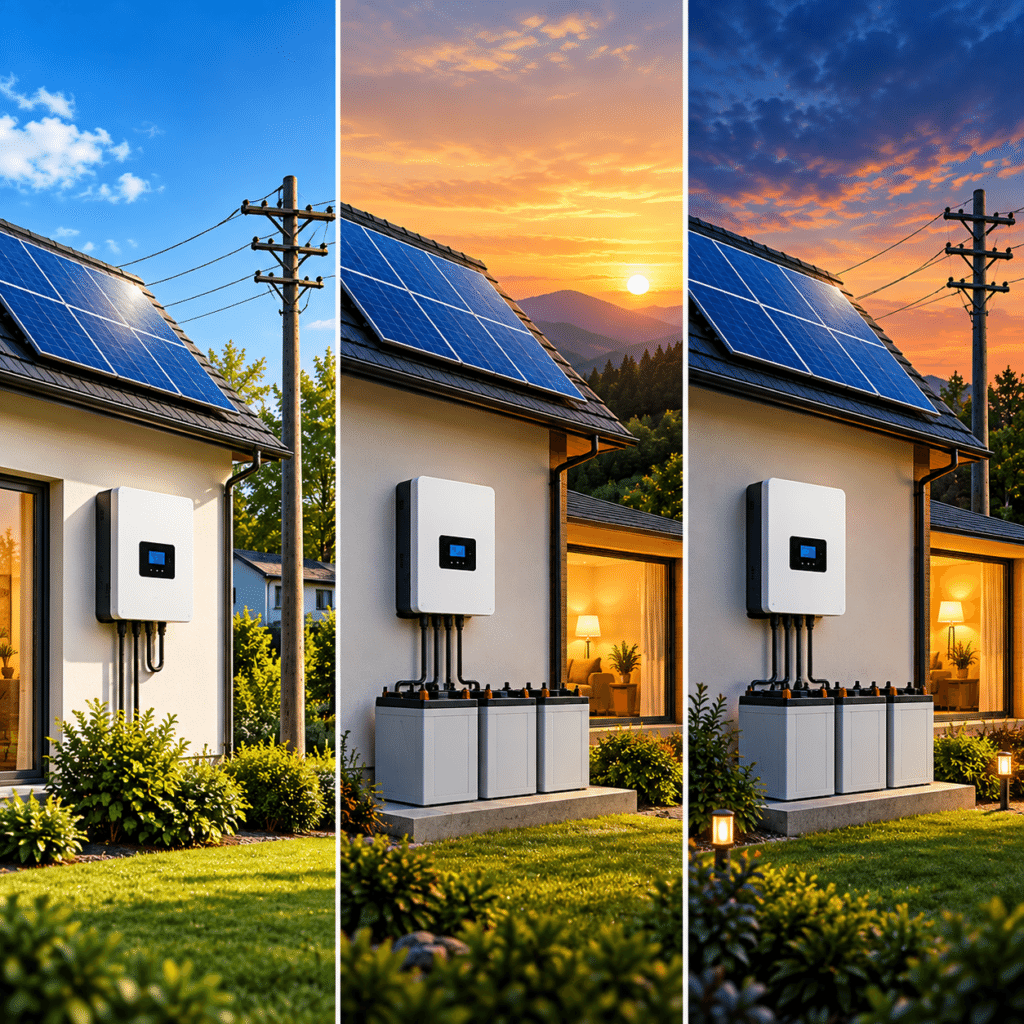
Choosing a solar inverter for residential homes comes down to one core trade-off: how much you value low upfront cost versus power security during outages. There are three inverter categories, and each is built for a different kind of household.
- On-grid inverters stay wired to the utility grid, skip the battery entirely, and typically cost 30-40% less than a hybrid setup for the same panel capacity. They’re the go-to home solar inverter choice when your area has stable electricity and a working net metering program, but they switch off completely during a blackout — even in bright daylight — because of a built-in safety feature called anti-islanding.
- Off-grid inverters run entirely on solar and battery power with zero grid connection. They’re the right fit for farmhouses, hill stations, or rural properties where grid lines simply don’t reach, but they demand a battery bank sized for 1-3 days of autonomy and generally push total system cost up by 60-100% compared to a similar-sized on-grid system.
- Hybrid inverters blend both worlds — solar, battery, and grid — switching between sources automatically. They’re increasingly the default recommendation for residential solar power backup systems in areas with frequent short outages, since they preserve net metering benefits while still keeping the lights on when the grid drops.
The rest of this guide breaks down how each type actually works, real-world cost and efficiency figures, and a decision framework you can apply to your own home — whether you’re comparing a solar inverter for house installations, a small rooftop system, or a full residential microgrid.
Why the Inverter Type Is the Most Important Decision in a Solar Installation
Solar panels get most of the attention, but the inverter is the component that decides how your system actually behaves day to day. It governs three things that matter to almost every homeowner evaluating a residential solar inverter:
- Whether you have electricity when the grid goes down — a factor that matters most in regions with unreliable utility infrastructure or frequent storms.
- How much of your generated solar energy you can actually use or monetize, through self-consumption, battery storage, or grid export credits.
- Total system cost and payback timeline — inverter and battery selection typically account for 25-35% of a residential solar project’s total budget.
A quality inverter also affects efficiency. Most modern residential inverters operate at a conversion efficiency between 95% and 98.5%, meaning only 1.5-5% of the DC power generated by your panels is lost during conversion to usable AC power. That efficiency gap sounds small, but across a 5kW system running for 20+ years, it can translate to a meaningful difference in lifetime energy output — which is why inverter selection deserves as much research as panel selection.
On-Grid Solar Inverter (Grid-Tied Inverter)
An on-grid inverter — sometimes called a grid-tied or grid-interactive inverter — connects your rooftop solar array directly to the public electricity grid. There’s no battery in the loop. Any solar power you don’t use immediately gets pushed out to the grid, and at night or on cloudy days, your home simply pulls electricity back from the grid as usual.
How It Works
Solar Panels → On-Grid Inverter → Home Load → Surplus Power → Grid (Net Metering)
Key Features
- No battery required, which keeps upfront cost roughly 30-40% lower than a comparable hybrid system
- Automatic shutdown during outages — a mandatory safety mechanism (anti-islanding) that prevents your system from feeding power into grid lines that utility workers may be repairing
- Full net metering compatibility, letting you bank exported units as credit against your future electricity bill
- Compact, simple design with fewer components — generally the lowest-maintenance option of the three
- Typical residential payback period: 4 to 6 years, depending on local tariff rates and sunlight hours
Best For
Homeowners in urban or semi-urban areas with dependable grid supply, an active net metering policy, and a priority on minimizing installation cost.
Pros and Cons
| Pros | Cons |
| Lowest upfront cost of the three types | Zero backup power during a grid outage |
| Fastest payback period (often under 6 years) | Fully dependent on grid stability |
| Simple installation, minimal maintenance | No storage flexibility for excess solar power |
Off-Grid Solar Inverter (Standalone Inverter)
An off-grid inverter operates completely independently of the utility grid. It draws DC power from your solar panels, routes it through a charge controller into a battery bank, and then converts stored battery power into usable AC electricity for your home — with no grid connection anywhere in the system.
How It Works
Solar Panels → Charge Controller → Battery Bank → Off-Grid Inverter → Home Load
Key Features
- Requires a dedicated battery bank, usually sized to provide 1-3 days of backup depending on household consumption and local weather patterns
- Complete independence from utility infrastructure — a genuine advantage in areas with no grid access at all
- Batteries are typically cycled to 50-80% depth of discharge to preserve battery lifespan, meaning your usable battery capacity is lower than its rated capacity
- Higher upfront investment — off-grid systems generally cost 60-100% more than an equivalent on-grid setup, largely due to battery and controller costs
- No net metering benefit, since there’s no grid connection to export power into
Best For
Remote homes, farmhouses, hill properties, or any location where grid electricity simply isn’t available or is too unreliable to depend on.
Pros and Cons
| Pros | Cons |
| Total independence from the utility grid | Highest upfront cost of the three inverter types |
| Reliable power supply in remote or off-grid locations | No net metering or grid export option |
| Eliminates electricity bills entirely | Requires precise load calculation and battery sizing |
Hybrid Solar Inverter
A hybrid inverter is essentially a smarter, dual-mode version of the previous two. It stays connected to the grid like an on-grid system, but also manages a battery bank like an off-grid system — automatically shifting between solar, battery, and grid power based on real-time availability and household demand.
How It Works
Solar Panels → Hybrid Inverter → Home Load Hybrid Inverter ⇄ Battery (charges/discharges as needed) Hybrid Inverter ⇄ Grid (imports when needed, exports surplus)
Key Features
- Delivers genuine backup power during outages, using stored battery energy to keep essential circuits running
- Retains full net metering compatibility, so surplus power beyond what the battery needs can still be exported to the grid
- Smart energy management algorithms prioritize self-consumption first, then battery charging, then grid export — a sequence that maximizes bill savings
- Modular and scalable: many households install a hybrid inverter first and add battery capacity later, spreading out the investment
- Positioned as the most future-proof inverter for residential homes, particularly as battery prices continue trending downward year over year
Best For
Homeowners who want a genuine backup solution for outages without giving up the financial benefits of grid connectivity and net metering — which, in practice, describes the majority of residential buyers today.
Pros and Cons
| Pros | Cons |
| Combines backup power with grid export benefits | Higher upfront cost than a basic on-grid system |
| Most flexible and future-proof configuration | Installation and configuration are more technically involved |
| Maximizes self-consumption and long-term savings | Battery component adds a replacement cost every 8-12 years |
On-Grid vs Off-Grid vs Hybrid: Complete Comparison Table
| Feature | On-Grid | Off-Grid | Hybrid |
| Grid connection | Yes | No | Yes |
| Battery required | No | Yes (mandatory) | Optional, but recommended |
| Power during outage | No | Yes | Yes |
| Net metering / grid export | Yes | Not applicable | Yes |
| Typical conversion efficiency | 96-98.5% | 93-97% | 95-98% |
| Relative upfront cost | Lowest (baseline) | +60% to +100% | +30% to +60% |
| Typical residential payback period | 4-6 years | 7-10+ years | 5-8 years |
| Energy independence | Low | Highest | Medium-High |
| Ideal environment | Stable urban grid | No grid access | Unstable or outage-prone grid |
Cost and payback figures are general industry ranges for residential rooftop systems and will vary by system size, local electricity tariffs, subsidy availability, and installation region.
Which One Should You Choose?
Rather than picking based on price alone, walk through these three questions:
- How often does your grid actually go down? If outages are rare and brief, an on-grid system captures most of the financial upside with the least cost. If outages happen weekly or last for hours, that changes the math entirely in favor of hybrid or off-grid.
- Does grid infrastructure reach your property at all? If the answer is no — common in rural or hill locations — off-grid is your only real option, regardless of cost.
- Are you planning to add battery storage eventually, even if not today? If yes, installing a hybrid-ready inverter now is usually more cost-effective than replacing an on-grid inverter later, since not every on-grid model supports a battery retrofit.
In short:
- On-grid → stable grid, lowest cost priority, net metering available
- Off-grid → no grid access, full independence required
- Hybrid → outage-prone grid, want backup power without losing net metering, planning future battery expansion
Frequently Asked Questions
Q: Which solar inverter is best for residential homes with frequent power cuts?
A: A hybrid inverter is generally the best fit for homes with frequent power cuts. It draws on stored battery power to keep essential appliances running during an outage, while still remaining connected to the grid for net metering benefits when power is available.
Q: Can an on-grid inverter provide power during a blackout?
A: No. On-grid inverters are designed to shut down automatically during a grid outage, even if solar panels are actively generating electricity. This anti-islanding safety feature protects utility line workers from unexpected voltage during repairs.
Q: How much more does a hybrid inverter cost compared to an on-grid inverter?
A: A hybrid inverter setup typically costs 30-60% more than an equivalent on-grid system, mainly due to the added battery and smart energy-management hardware. The exact difference depends on battery capacity and brand.
Q: What is the average efficiency of a residential solar inverter?
A: Most quality residential inverters operate between 95% and 98.5% efficiency, meaning a small percentage of generated DC power is lost during conversion to AC. Off-grid systems tend to sit slightly lower, around 93-97%, due to additional battery charge-discharge losses.
Q: Do off-grid solar systems need a backup generator?
A: Many off-grid installations include a backup generator to cover extended low-sunlight periods, since the battery bank is the sole power source and can be depleted after several consecutive cloudy days.
Q: Can an existing on-grid inverter be upgraded to hybrid later?
A: It depends on the model. Some on-grid inverters are not battery-compatible by design. If you anticipate wanting backup power in the next few years, it’s usually more economical to install a hybrid-ready inverter from the start rather than replacing the unit later.
Q: How long does a residential solar inverter typically last?
A: Most residential inverters carry a manufacturer warranty of 5-10 years and a realistic operational lifespan of 10-15 years, roughly half the typical 25-year lifespan of solar panels — which is why inverter replacement is a normal part of long-term solar ownership.
Final Takeaway
There’s no universally “best” inverter — only the one that matches your grid reliability, budget, and backup needs. On-grid systems remain the most cost-efficient entry point where utility power is dependable. Off-grid systems are the only viable path for genuinely remote properties. And hybrid inverters have emerged as the practical middle ground for most residential buyers, offering outage protection without sacrificing the long-term savings that come from staying connected to the grid. Whichever route you take, matching the inverter type to your actual usage pattern — not just the sticker price — is what determines whether your solar investment pays off the way you expect.