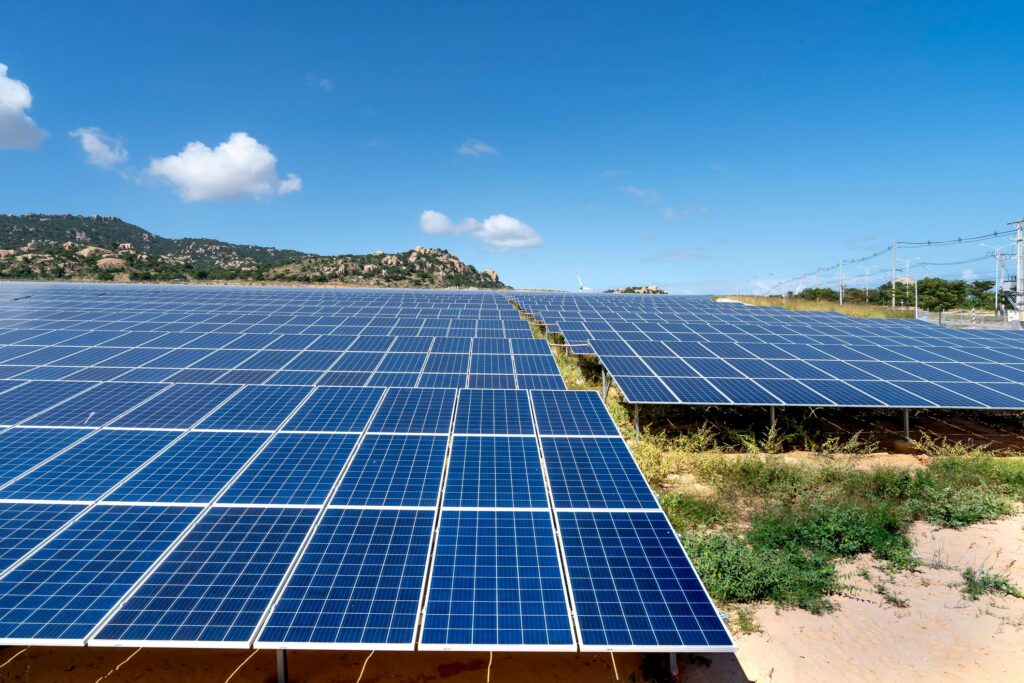
A decade ago, India didn’t really make solar panels; it bought them. Most modules going onto Indian rooftops and solar farms were shipped in, largely from China, and the idea of a homegrown solar supply chain felt more like a five-year-plan slide than a working industry.
That has changed faster than almost anyone predicted. Module manufacturing capacity has gone from roughly 2.3 gigawatts (GW) in 2014 to well over 120 GW today, and India has climbed to become the world’s third-largest producer and installer of solar power. But the headline growth number only tells half the story. The more interesting and more useful story is why this happened, where it’s genuinely working, and where the industry is still exposed. That’s what this piece digs into.
From Import Dependence to a Domestic Supply Chain
India’s installed solar capacity crossed roughly 130 GW by late 2025, up from under 3 GW in 2014, a jump that took the country from a marginal player to the world’s third-largest solar market. On the manufacturing side, the shift is even sharper: cell manufacturing capacity has climbed to around 29 GW and module capacity to over 120 GW, according to industry tracking as of mid-2025.
Two policy instruments did most of the heavy lifting:
- The Production Linked Incentive (PLI) scheme, approved in 2021 with a total outlay of ₹24,000 crore across two tranches, pays manufacturers cash incentives after they actually produce and sell high-efficiency modules, not simply for building a factory. That “pay for output, not promises” structure is deliberate; it’s designed to filter out speculative capacity.
- The Approved List of Models and Manufacturers (ALMM), run by the Ministry of New and Renewable Energy, functions as a gatekeeper. Only ALMM-certified, domestically produced modules and cells qualify for subsidised government schemes such as PM Surya Ghar, PM-KUSUM, and most DISCOM net-metering connections. From mid-2026, the list has tightened further, effectively locking a large share of the domestic market to Indian-made products.
Together, these two levers did something policy alone rarely manages: they created durable, mandated domestic demand and rewarded manufacturers only when they delivered.
The Critical Upstream Gap Most Coverage Misses
Here’s where a lot of the celebratory reporting on India’s solar boom stops short — and where it’s worth being honest about the numbers.
India’s module and cell manufacturing capacity has grown remarkably. Its polysilicon and wafer capacity has not. As of mid-2025, India had approximately 3.3 GW of polysilicon capacity and 5.3 GW of wafer manufacturing capacity, compared with 29 GW of solar cell capacity and 120 GW of module manufacturing capacity. In plain terms: India can assemble panels at serious scale, but it still imports most of the raw silicon wafers and cells that go into them, largely from China.
Execution has also lagged targets. By June 2025, only about 31 GW of the 65 GW of PLI-supported module capacity that was originally committed had actually been commissioned, against pledged investment of roughly ₹48,120 crore versus an initial target of ₹94,000 crore. Independent analysis from IEEFA notes that PLI awardees who miss their commitments face a combined financial exposure, through bank guarantee encashment, forfeited incentives, and lost sales, running into tens of thousands of crores.
None of this means the PLI-ALMM push has failed. It means the sector is in a genuinely difficult, capital-intensive build-out phase, and the manufacturers who survive it will be the ones with strong balance sheets, real technology (not just assembly-line capacity), and the patience to work through commissioning delays.
Where the Growth Is Actually Happening
Manufacturing clusters have concentrated around a handful of states offering land, power, and incentive support; Gujarat, Rajasthan, Tamil Nadu, and Andhra Pradesh have emerged as the country’s core solar manufacturing belts. Large, vertically integrated players, including Adani, Waaree, TATA, Vikram Solar, and Reliance Industries, are the ones pushing furthest upstream, investing not just in module assembly but in cell, wafer, and in some cases polysilicon capacity, alongside adjacent bets on battery storage and green hydrogen.
Smaller manufacturers and MSMEs still have room to compete, particularly in module assembly, which needs a comparatively modest investment of roughly ₹3–5 crore versus ₹13–20 crore for cell manufacturing. But industry analysts increasingly expect consolidation: companies with weak margins, excess capacity, or outdated technology are likely to come under pressure, while scaled, well-capitalised players absorb market share.
The 2030 Roadmap: Bigger Than Just Panels
India’s renewable energy ambitions extend far beyond expanding module manufacturing. By 2035–36, the country aims to achieve 509 GW of solar capacity, 155 GW of wind capacity, and 174 GW (888 GWh) of energy storage, including 80 GW of battery storage and 94 GW of pumped hydro storage. As an interim milestone, India is targeting 280–300 GW of installed solar capacity by 2030. Achieving this goal will require sustaining annual solar capacity additions of around 50 GW, a pace the country has only recently approached, with a record 44 GW installed during the 2025–26 financial year.
That means the next phase of growth isn’t just about building more module factories. It depends on:
- Upstream integration: Closing the polysilicon and wafer gap so India isn’t dependent on imported inputs to make “domestic” panels
- Grid modernisation: Enough transmission and storage capacity to actually absorb the power being built
- Workforce development: A technically trained labour pool, built through industry-academia partnerships, to run increasingly automated, digitised manufacturing lines
- Recycling and circularity: As the first wave of panels installed a decade ago nears end-of-life, materials recovery becomes a real industrial question, not a future one
What This Means If You’re Building, Investing, or Buying
If you’re a developer or EPC contractor: ALMM compliance isn’t optional anymore for subsidy-linked or government-adjacent projects. Cross-check any manufacturer against both PLI and ALMM listings. PLI approval confirms government incentive eligibility, not manufacturing quality, so it’s worth verifying BIS certification and independent reliability data separately.
If you’re evaluating manufacturers as an investor or supplier: Scale alone isn’t the differentiator anymore. Balance sheet strength, upstream integration (cell/wafer, not just module assembly), and a track record of hitting commissioning milestones matter more than headline capacity announcements.
If you’re a homeowner or business buying rooftop solar: Expect Indian-manufactured modules to carry a modest price premium over imports in the near term, with convergence expected over the next two to three years as domestic scale matures. Inconsistent net-metering implementation and, in some states, subsidised grid electricity are still real barriers to rooftop adoption; the constraint is often policy execution, not the technology or the panels themselves.
The Honest Bottom Line
India’s solar manufacturing boom is real, and it’s one of the more consequential industrial shifts happening in the country right now; a near 50x jump in manufacturing capacity in a decade is not a rounding error. But it’s also a story still being written. The country has proven it can build assembly-scale capacity fast when policy creates mandated demand. What it hasn’t yet proven is that it can close the upstream gap in polysilicon and wafers, hit its own commissioning targets consistently, and do all of this while scaling storage and grid infrastructure fast enough to match.
The next four years through 2030 will likely decide whether India ends up as a genuine, globally competitive solar manufacturing hub, or a large assembly base still leaning on imported inputs for its core materials. Both the momentum and the gaps are worth watching closely, because they’ll shape everything from panel prices to energy security for the rest of the decade.
Frequently Asked Questions
How much has India’s solar manufacturing capacity grown?
Module manufacturing capacity has grown from about 2.3 GW in 2014 to over 120 GW as of late 2025, roughly a 50-fold increase in just over a decade.
What is the PLI scheme for solar manufacturing?
The Production Linked Incentive scheme is a ₹24,000 crore government program, approved in 2021, that pays manufacturers cash incentives based on the actual volume of high-efficiency solar modules they produce and sell, not simply for setting up capacity.
What is ALMM and why does it matter? The Approved List of Models and Manufacturers (ALMM) is a government-maintained registry of certified domestic solar manufacturers. Only ALMM-listed modules and cells qualify for subsidy-linked or government-funded solar projects, including PM Surya Ghar and PM-KUSUM.
Is India still dependent on imports for solar components?
Yes, significantly, at the upstream level. While module and cell capacity have scaled rapidly, India’s polysilicon and wafer manufacturing capacity remains far smaller, meaning much of the raw material still comes from imports, primarily China.
What is India’s target for solar energy capacity by 2030?
India aims to achieve 280–300 GW of installed solar capacity by 2030, requiring approximately 50 GW of new capacity additions each year to stay on track for its long-term target of 509 GW of solar capacity by 2035–36.