Across Gujarat, factory owners are facing a common challenge, electricity costs continue to rise while operational margins become tighter.
For industries such as textile, pharma, engineering, packaging, ceramic, plastic, cold storage, food processing, and manufacturing units, power cost is no longer just a utility expense; it directly impacts profitability.
Most industrial businesses today are already dealing with multiple operational pressures:
- Rising electricity tariffs
- Peak operational loads
- Increasing production costs
- Margin pressure
- Dependence on grid power
- Long-term energy cost uncertainty
- Need for stable operating expenses
And somewhere between managing production targets, workforce planning, and business expansion, electricity quietly becomes one of the largest recurring expenses for many industries.
That is one of the biggest reasons industrial solar in Gujarat has seen rapid growth in recent years. Businesses are increasingly viewing solar not simply as an environmental initiative, but as a long-term cost-control strategy.
Across industrial regions such as Sanand GIDC, Changodar, Chhatral, Vatva, Naroda, Odhav, Bakrol, Mehsana, Kalol, Gandhinagar, Kadi, Vijapur Road industrial areas, and nearby private industrial estates across Gujarat, industries are beginning to realize something important:
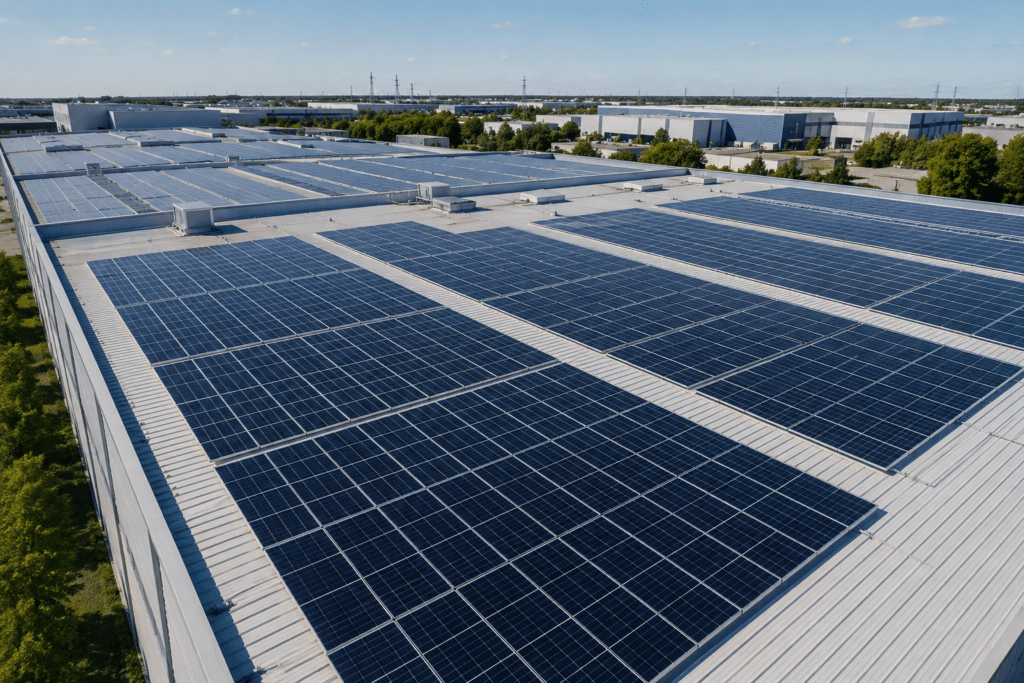
Your factory rooftop is no longer just unused space, it has the potential to become a long-term business asset.
Can Solar Really Reduce Industrial Electricity Costs by Up to 70%?
The answer depends on multiple practical factors.
Depending on sanctioned load, rooftop area, daytime consumption pattern, tariff category, and system design, many industries can significantly reduce grid electricity dependency, in some cases by up to 70%.
Rather than depending on electricity entirely from the grid, industries with a properly designed and planned solar power system can generate a significant portion of their own energy during working hours.
The impact often becomes visible through:
- Lower monthly electricity bills
- Reduced operating costs
- Better budget predictability
- Protection from future tariff increases
- Improved profitability over time
Since many manufacturing facilities operate heavily during daytime hours, solar generation often aligns closely with actual consumption patterns.
This makes rooftop solar for factory operations technically and financially practical.
Why Gujarat Is One of the Strongest Markets for Industrial Solar
Gujarat has become one of India’s strongest markets for industrial rooftop solar solutions due to several practical advantages.
Industries across Gujarat benefit from:
- Strong solar radiation throughout the year
- Large factory rooftop areas
- High daytime energy consumption
- Expanding industrial growth zones
- Rising commercial and industrial electricity tariffs
Whether in Vatva, Naroda, Chhatral, Sanand, or Mehsana industrial belts, industries are increasingly exploring commercial solar installation to improve long-term operational efficiency.
For many businesses, reducing electricity bill with solar is no longer considered optional, it is becoming a strategic decision.
Industrial Solar Is Not an Expense — It Is a Long-Term Operational Asset
A common concern among industrial owners is:
“Solar requires high investment.”
However, industrial solar should not be viewed as an expense.
It is a long-term operational cost-control asset.
Grid electricity is a recurring expense that generally increases over time, while solar helps stabilize and reduce energy costs for decades.
Most businesses already spend substantial amounts every month on electricity without creating any long-term value from that expense.
A properly designed solar system works differently.
After installation, it continues generating electricity and reducing operational costs for years while the business continues functioning normally.
Few investments provide both cost reduction and long-term predictability at the same time.
Why System Design and Execution Matter More Than Panels Alone
Many businesses assume that installing solar panels automatically guarantees savings.
Practical experience shows that this is not always true.
Long-term performance depends heavily on:
- Engineering and system design
- Rooftop condition assessment
- Structure quality
- Safety standards
- Cable and electrical planning
- Installation quality
- Generation optimization
- Long-term service support
Poor execution can lead to:
- Lower energy generation
- System inefficiencies
- Increased maintenance issues
- Safety risks
- Reduced project lifespan
For industrial operations, even small inefficiencies can directly impact costs over time.
Why Industries Across Gujarat Choose Ample Solar
With experience across residential, commercial, and industrial solar projects in Gujarat, Ample Solar understands the practical challenges industries face, including rooftop conditions, DISCOM approvals, structure quality, safety standards, generation optimization, and long-term service support.
Unlike a standard installation approach, industrial projects require practical planning based on actual consumption patterns and business requirements.
As an industrial solar EPC company, Ample Solar focuses on designing solutions that support long-term operational performance rather than short-term installation targets.
Ample Solar + Tata Power Solar Quality Advantage
Quality becomes even more important when industries expect performance over the next 25–30 years.
Ample Solar follows a structured installation and quality-check process.
After installation, the engineering team conducts internal quality inspections before final commissioning and warranty activation.
For Tata Power Solar projects, proper quality and documentation standards are maintained to ensure long-term reliability and customer confidence.
As a Tata Power Solar channel partner Gujarat businesses can rely on, the focus remains on:
- High-quality installation practices
- Proper engineering standards
- Long-term performance reliability
- Structured documentation and support
- Better customer confidence
Solar Is Becoming a Competitive Business Advantage
A few years ago, solar was largely viewed as a sustainability initiative.
Today it is becoming something much more practical:
A long-term operational strategy.
Businesses reducing dependence on grid electricity are improving cost control, strengthening operational stability, and reducing future energy-related uncertainty.
As competition increases across industrial sectors, lower operating costs directly influence profitability and business sustainability.
Book a Free Industrial Solar site visit
Every industry operates differently.
The ideal solar system depends on electricity consumption patterns, available rooftop area, sanctioned load, and operational timing.
Book a free industrial solar visit with Ample Solar.
Our team can evaluate your electricity consumption, rooftop area, and operational pattern to estimate potential savings and overall project feasibility.
Your factory rooftop is not just unused space anymore. With the right solar planning and execution, it can become one of the smartest long-term cost-saving assets for your business.